Blog / Mobility
Why pressing overhead hurts after fifty
Most men who cannot get their arms comfortably overhead do not have a shoulder problem. They have a ribcage that will not extend, and a shoulder that is being asked to make up the difference.
Test it before you blame it
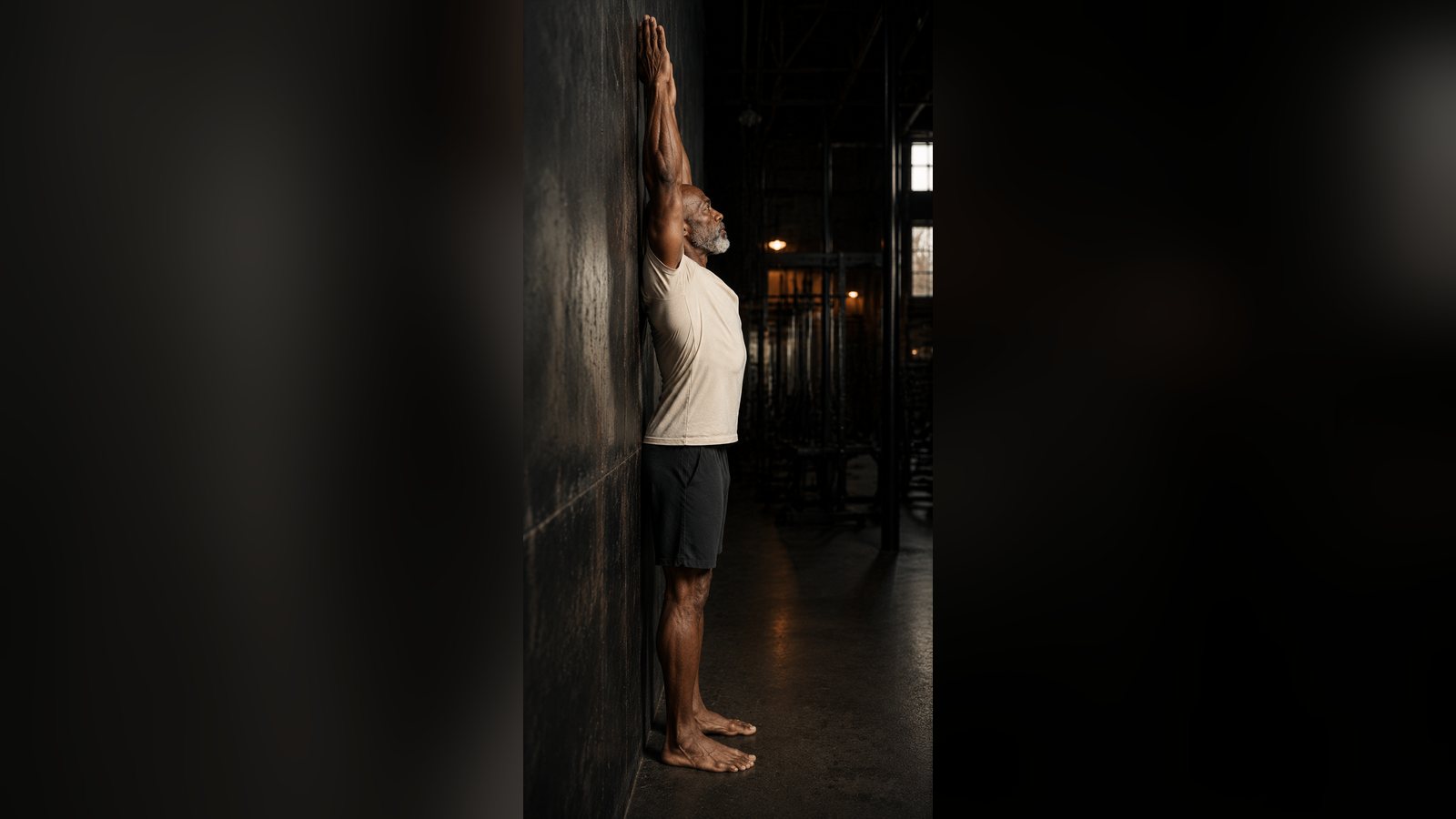
Lie on your back with your knees bent and press your low back flat into the floor. Keep it flat, and reach both arms overhead toward the wall behind you.
If the arms reach the floor with the low back still flat, your overhead range is fine and something else is causing the pain. If the ribs flare or the back arches to get there, you did not get there. The lumbar spine handed over range that the shoulder did not have.
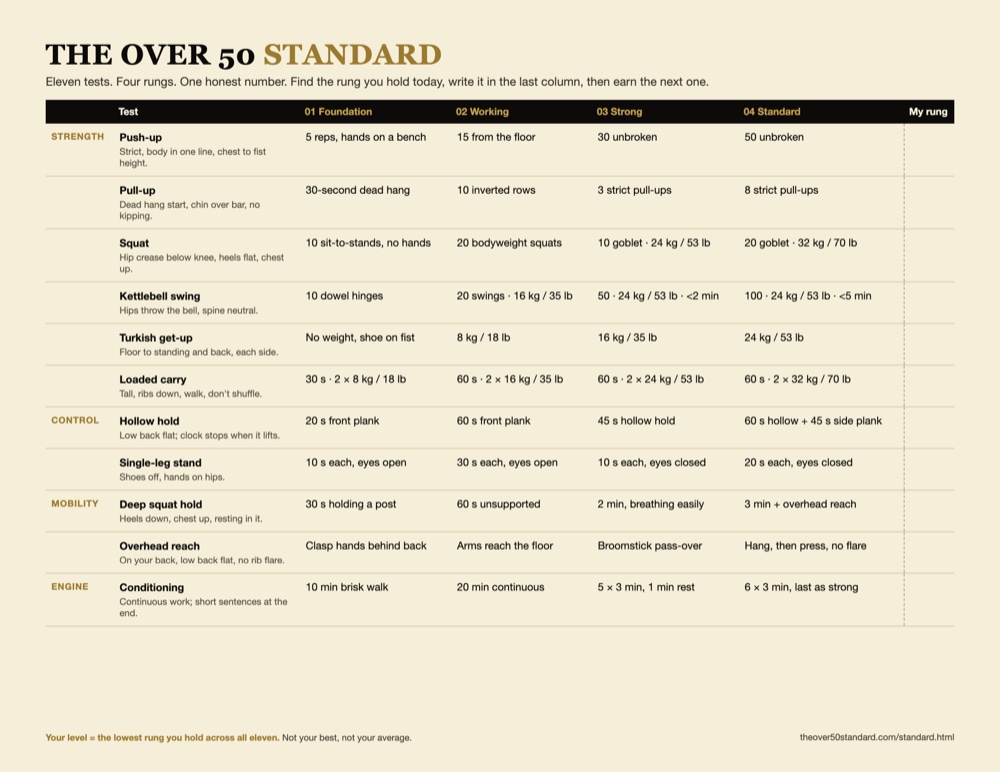
That is the overhead reach test, and it is one of the eleven for exactly this reason: almost everybody passes it if they are allowed to cheat, and the cheat is invisible unless someone tells you to look for it.
The mid-back is usually the culprit
The shoulder blade sits on the ribcage. To get an arm fully overhead, the thoracic spine has to extend and the blade has to rotate upward on it. If the mid-back is stiff, the blade cannot travel, and the arm bone jams into the top of the socket instead.
Decades of sitting shortens exactly that range. It is not an injury and it is not arthritis. It is a range of motion the body stopped maintaining because nothing asked for it.
What actually changes it
A foam roller across the upper back, slow, before every session. Not on the low back, which does not need more extension. Upper back only, a few minutes.
Broomstick pass-overs. Wide grip, straight arms, over and back. Narrow the hands an inch every couple of weeks. This is the clearest progress marker in the whole standard, because the distance between your hands is a number.
Dead hangs from a bar. A hang is overhead mobility under load, which is why it sits in the Standard rung of the reach test. It also happens to be the Foundation rung of the pull-up test, so the work counts twice.
When it is not mobility
Pain that is sharp, that wakes you at night, that follows a specific incident, or that comes with weakness rather than stiffness is a different conversation and belongs with a physiotherapist or a doctor. Nothing here is medical advice.
The distinction that matters day to day: stiffness eases as you move and pain does not. If ten minutes of gentle work makes the shoulder feel better, you are dealing with range. If it makes it worse, stop and go and get it looked at.
Press from where you actually are
While the range comes back, press at an angle you own rather than the one you want. A press that stops where the ribs start to flare is a real press. One that continues past it is a lumbar extension with a weight in your hands.
The range comes back faster than strength does, and it is low-effort daily work rather than hard work. That is precisely why most people never do it.