Blog / Training
How often should you train after fifty?
Three days a week, with a day between each, covers almost everybody. Not because older men are fragile, but because the thing that changed is the time between sessions, not what happens inside them.
What actually changed
Muscle still responds to training in the fifties, sixties and seventies. The research on this is not ambiguous and it has not been for a long time. What slows down is the repair between sessions.
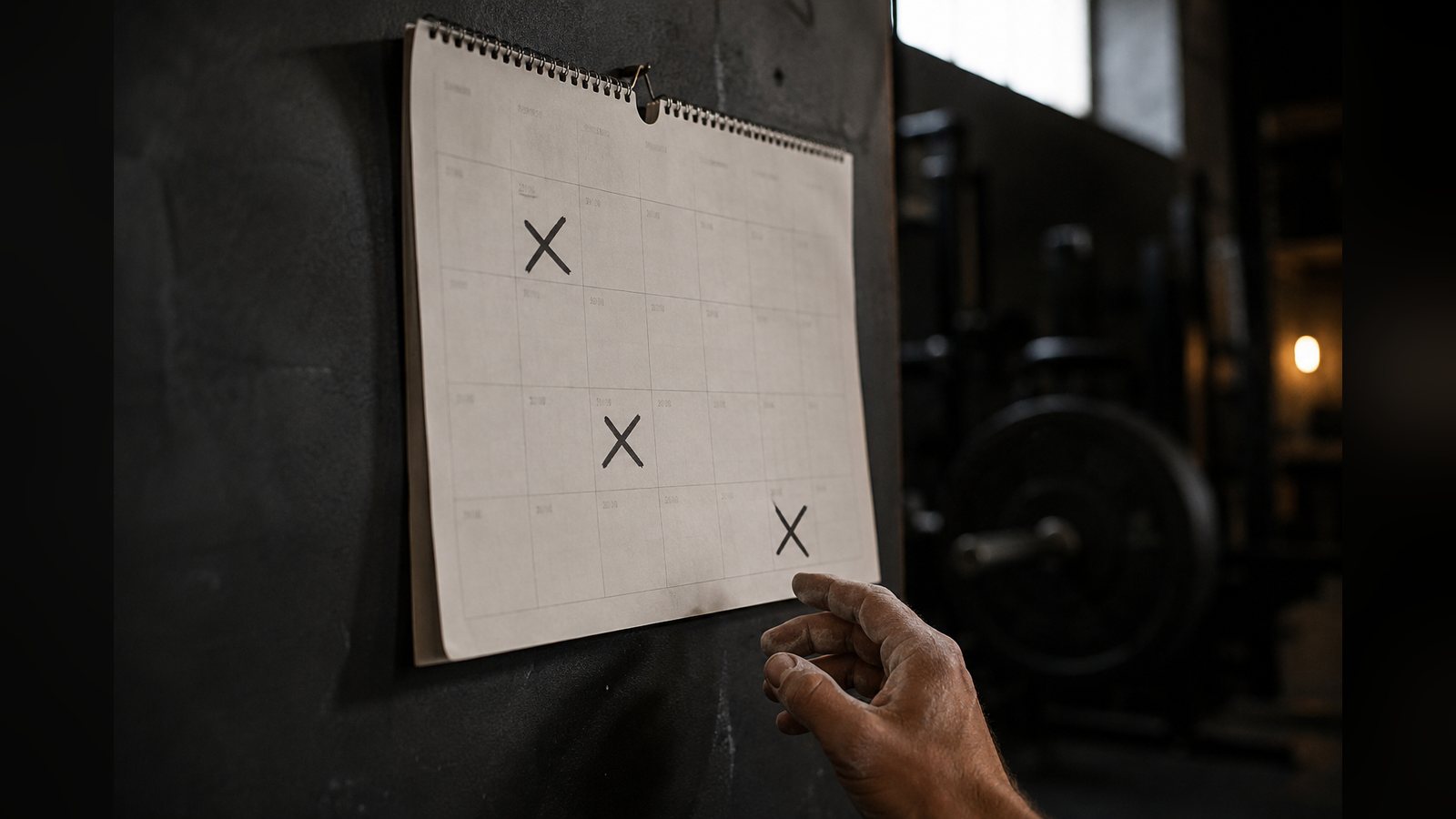
That means the same weekly volume delivered across three days recovers better than across five, and the man training three days often out-progresses the man training five and arriving at each session already behind.
The number that matters is not sessions per week. It is quality sessions per week, and a session you turn up to tired is not one of them.
A week that works
Three strength sessions, each covering one push, one pull, one leg movement, and one carry or hold. Twenty to forty minutes.
Two conditioning pieces, which can be walking, rope, a bag or a bike. Continuous rather than intervals to failure. At the end you should be able to speak in short sentences.
Ten minutes of mobility daily, which is not a session and does not need recovery. The deep squat hold and the overhead reach both live here, and both are trained by accumulation rather than effort.
That is five to six touches a week, of which only three are hard. Most men who burn out were doing five hard ones.
Volume beats failure
Six sets of a number you can hit cleanly, three times a week, builds more than one set to failure. This is true at any age and it becomes true with a vengeance past fifty, because failure is a recovery cost and volume is not.
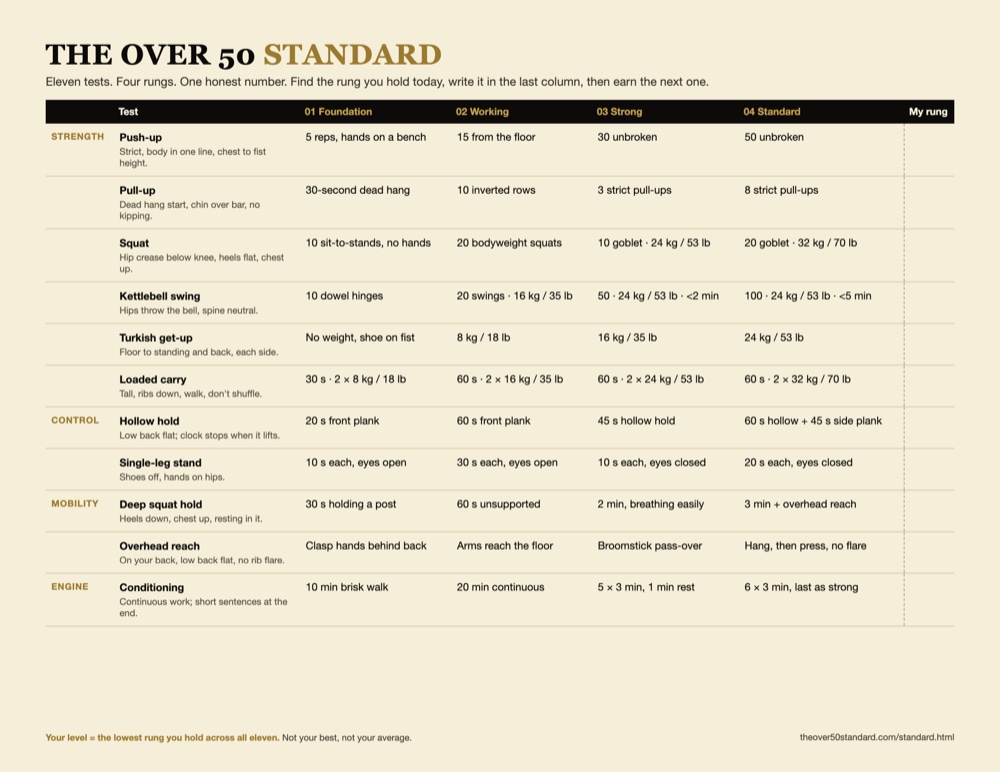
It is also the fastest way to move the push-up test. Fifty unbroken push-ups is a Standard-rung number and nobody gets there by grinding out one set to failure. They get there by doing thirty clean sets a week.
Deload before you need to
Every fourth week, cut the volume in half and keep the movements the same. Not a week off, a lighter week.
The point is to take the deload before the body takes it for you. An unplanned deload is called an injury, and it lasts six weeks rather than one.
How to know it is working
Retest every eight weeks, not every week. Weekly you are measuring sleep, coffee and mood. Eight weeks is long enough for the number to mean something.
Your level is the lowest rung you hold across all eleven tests, which means the fastest way to raise your score is almost never the thing you enjoy training. It is the test you have been quietly avoiding.