Blog / Training
Are kettlebell swings bad for your back?
A swing performed as a hinge is one of the friendliest things you can do for a back over fifty. A swing performed as a squat with a weight in it is one of the worst. The movement has a reputation because most people learn the second one.

The one fault that causes almost all of it
Hinging too early. The bell comes down, and instead of waiting for it to reach you, you fold at the hips while it is still out in front of your body. That turns the bottom of every swing into a loaded position with a long lever and a rounding back.
The cue is simple and it is worth saying out loud while you learn it: wait until your upper arms touch your ribs, then hinge. Not before. Every repetition.
The second fault: squatting it
If the knees travel forward and the bell dips toward the floor between your feet, that is a squat with a weight in it, not a swing. The hips are supposed to go back, not down, and the bell should pass above the knees on its way behind you.
This one is easy to see on film and almost impossible to feel. Set a phone on the floor beside you for one set and the answer is immediate.
The third: a soft finish
At the top of a swing you should be a plank standing up. Glutes squeezed hard, ribs down, trunk braced as though you were about to be punched.
If you are not doing that, the movement finishes with your lower back arching instead of your hips extending, and you get the same bill from the opposite direction. Sharp exhale at the top of every repetition. It sounds theatrical and it is what braces the trunk at the moment the load is highest.
Three weeks before the bell moves fast
This is the part everybody skips and it is the reason the movement has the reputation it has.
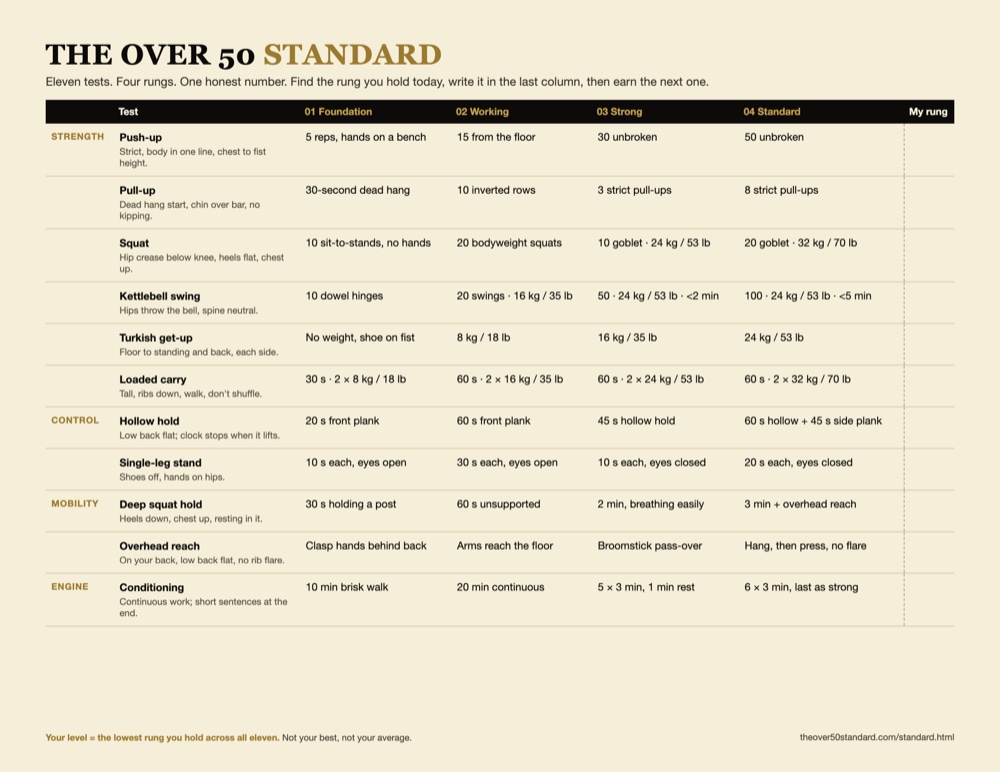
Wall drill: stand a boot's length from a wall, push the hips straight back until your backside touches, shins nearly vertical. Ten a day. Dowel drill: a broom handle held against the back of your head, your mid back and your tailbone, all three staying in contact through the whole hinge. Ten a day. Then deadlift the bell from the floor with the same pattern, three sets of eight, twice a week for three weeks.
The gate out of that block is twenty unbroken deadlifts with a back that has not changed shape by the twentieth, and no soreness the next day. Nobody has ever regretted taking a fourth week.
Sets of ten, not sets of fifty
The swing is a power movement, and power is the first thing to go when you get tired. Form breaks down around repetition twelve for most people, which is exactly where a set of thirty is still going.
Ten crisp repetitions, rest, ten more. A hundred sloppy swings is how backs get hurt and it is almost always the back half of long sets doing the damage.
When to stop rather than adjust
Back pain that runs down a leg, pain at rest, or pain that comes with weakness rather than stiffness is not a technique problem, and there is no set and repetition scheme that fixes it. Stop, get it looked at, and come back.