Blog / Mobility
Why your heels lift when you squat
Nine times out of ten it is the ankle, not the hips, and most men spend months stretching the wrong thing. There is a one minute test that settles it, and about three weeks of daily work that moves it.

The one minute test
Kneel in front of a wall with one foot flat on the floor, toes about four inches back from the skirting board. Drive that knee forward over the toes without letting the heel lift. Can it touch the wall?
Four inches is a good ankle. Two inches is common and workable. Under an inch and the ankle is why your squat falls backwards, and no amount of hip stretching will change it.
Do both sides. A difference between them is common and it is usually the side of an old sprain, which never fully got its range back because nobody told you it needed to.
Why the heel lifts
To get to the bottom of a squat, the shin has to travel forward over the foot. If the ankle will not allow that much travel, the only way to reach depth is to lift the heel and let the foot rotate, which is the body finding the range somewhere else.
Once the heel is up, the weight moves onto the front of the foot, the trunk pitches forward to compensate, and the whole position becomes something you survive rather than something you rest in.
The fix, ten minutes a day
Half kneeling with the front foot a hand's width from a wall. Drive the knee forward over the little toe with the heel glued down, and rock in and out slowly. Twenty repetitions a side. Move the foot back an inch every few days as it gets easier.
Then get into the bottom of a squat and stay there. Six holds of fifteen seconds beats two holds of forty-five, because a short hold is one you can do properly with the heels down, and a long one is one you spend on your toes.
Add the only piece of homework worth doing: sit in the bottom of a squat for thirty seconds whenever you are waiting for something. The kettle, the printer, the dog. Three of those a day is another ninety seconds of exactly the right exposure and it costs you nothing.
What about propping the heels
Putting a plate or a pair of lifting shoes under the heels makes the position reachable immediately, and there is nothing wrong with using it to train the squat while you fix the ankle.
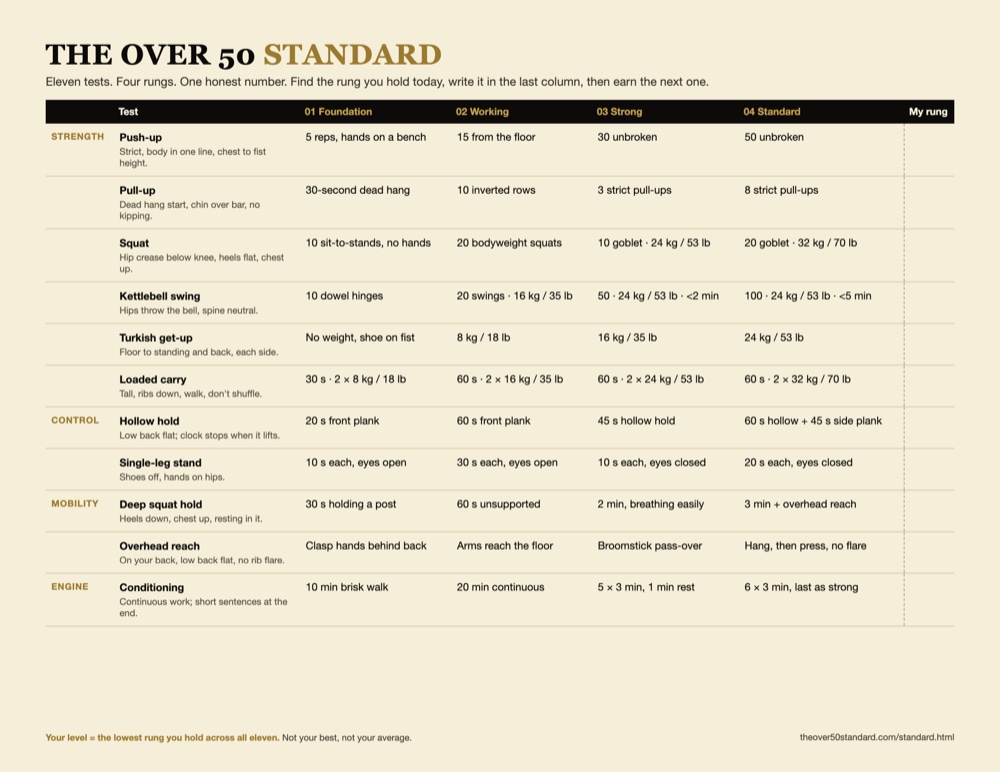
It is not the fix, though, and it does not count for the deep squat hold test. Hold a door frame instead and keep the heels on the floor. That is the honest version of the Foundation rung and it moves the actual problem.
When it is genuinely the hips
If the knee to wall test comes back at four inches and the squat still falls apart, the ankle is fine and the hip is the limit. Sit in the ninety-ninety position: front shin across your body at a right angle to your hips, back shin at a right angle to that, sitting tall without leaning back on your hands.
If you cannot sit upright there, that is the thing to train, and ninety seconds a day of it will change the squat inside a month.