Blog / Training
Can you still build muscle after fifty?
Yes, and the research on this is not close. What changes after fifty is not whether muscle responds. It is how much protein it takes to trigger the response, and how much longer everything holding the joint together needs to catch up.

The short answer, and the part people miss
Muscle built at fifty-five looks like muscle built at twenty-five. It arrives more slowly, it needs more food to arrive at all, and it needs the joints to survive the process, which is where most attempts actually fail.
The thing nobody warns you about is that the first eight to twelve weeks of any comeback are mostly not new muscle. They are your nervous system remembering how to recruit the muscle you already have. That is why the numbers move fast at first and then appear to stop. Nothing has gone wrong at that point. The easy part finished and the real part started.
What actually changed after fifty
Three things, and only one of them is about muscle.
The first is the response to a meal. A given serving of protein triggers a smaller building response than it used to, which means the same dinner that was plenty at thirty is merely adequate now. The fix is not exotic. It is more protein per meal and more meals that contain any.
The second is connective tissue. Tendon and the tissue around a joint adapt more slowly than muscle does, and they always did. At twenty-five the gap was small enough to ignore. At fifty-five it is the gap that ends comebacks in week three, when the muscle is ready for more and the elbow is not.
The third is recovery. Not the ability to recover, which is largely intact, but the time it takes. Three hard sessions a week with a day between them works. Five does not, and men who go from nothing to five sessions are usually back to nothing inside a month.
How long it takes, honestly
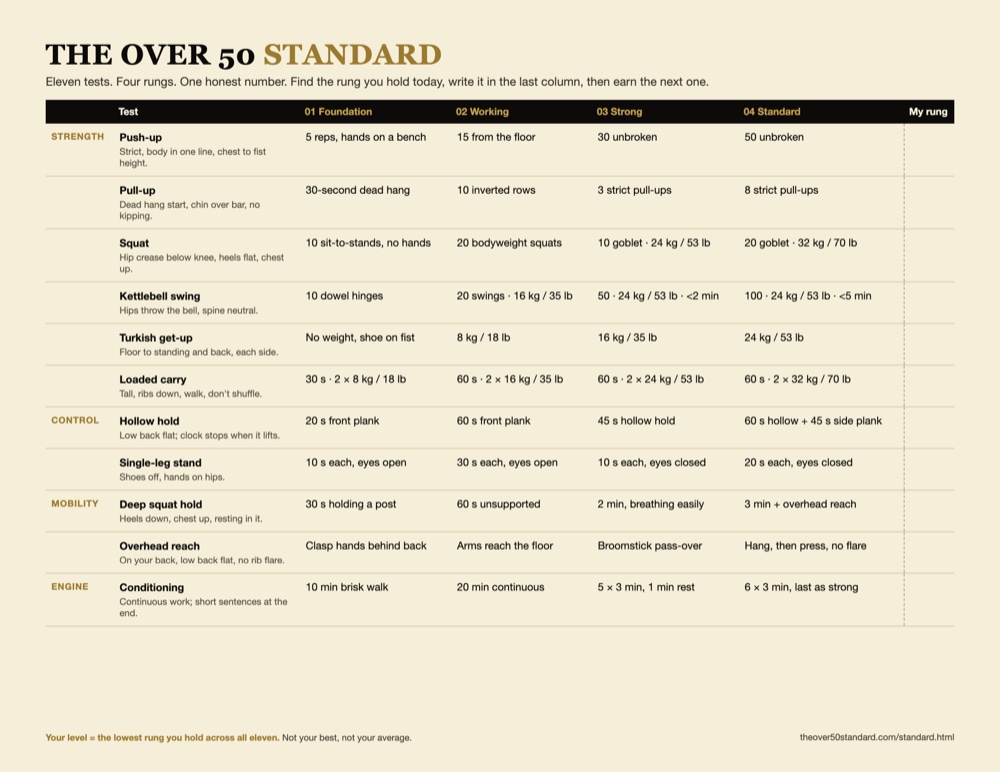
Visible change in about twelve weeks if the food is right. Measurable strength change in four to six. A rung on this standard in one twelve week block on two tests, which is a good result and a normal one.
The number that matters more than any of those is how many weeks in a row you trained. Twelve uninterrupted weeks of moderate work beats six brilliant weeks and six weeks nursing something, every single time, and it is not close either.
What to actually do
Three sessions a week, never on back to back days. Every session under forty-five minutes. Push, pull, hinge, squat, carry, and one thing for the trunk. Add one repetition per set per week until you cannot, then repeat the week.
Nothing goes to failure except the last set of one exercise per session, and you decide which one before you start rather than after. Training to failure on everything is how a fifty-five year old buys three weeks of soreness for one week of progress.
That is the whole of it. The programme is not the hard part and it never was.
The food, in one paragraph
Roughly your bodyweight in pounds, in grams of protein, spread across three or four meals rather than piled into dinner. Most men over fifty are thirty to fifty grams short of that and have no idea, because they have never counted it and their appetite has quietly dropped without telling them.
Fix breakfast first. It is the meal nobody defends, it is the same every day, and for most men it closes half the gap on its own.