Blog / Getting started
How to start training again after years off
The body remembers more than you think. What has changed is not your capacity, it is your recovery, and almost every failed comeback fails for the same reason: week one was a great workout and week three was an injury.

The comeback fails in week three, not week one
Men who trained in their twenties have a specific problem. You remember what you used to do, and on day one you can very nearly still do it. Your nervous system finds the old pattern within a session or two, and the weight moves.
What has not come back is everything that supports it. Tendons adapt more slowly than muscle. Connective tissue adapts more slowly still. So the first two weeks feel like proof that you have not lost it, and week three is when the elbow or the lower back sends the bill.
The fix is not to train timidly. It is to spend the first month buying yourself the right to train hard later.
The first four weeks
Three sessions a week, no more, with a full day between each. Each session is short: twenty to thirty minutes.
Every session covers one push, one pull, one leg movement and one carry or hold. That is it. No programme, no split, no accessory work.
Stop every set two or three reps before you would fail. If you could have done ten, do seven. This feels absurdly easy and it is the whole point. You are laying down volume without accumulating damage.
At the end of four weeks you will not be sore, you will not be injured, and you will be ready to actually train. Most people skip this month and spend it on injuries instead.
Test before you train
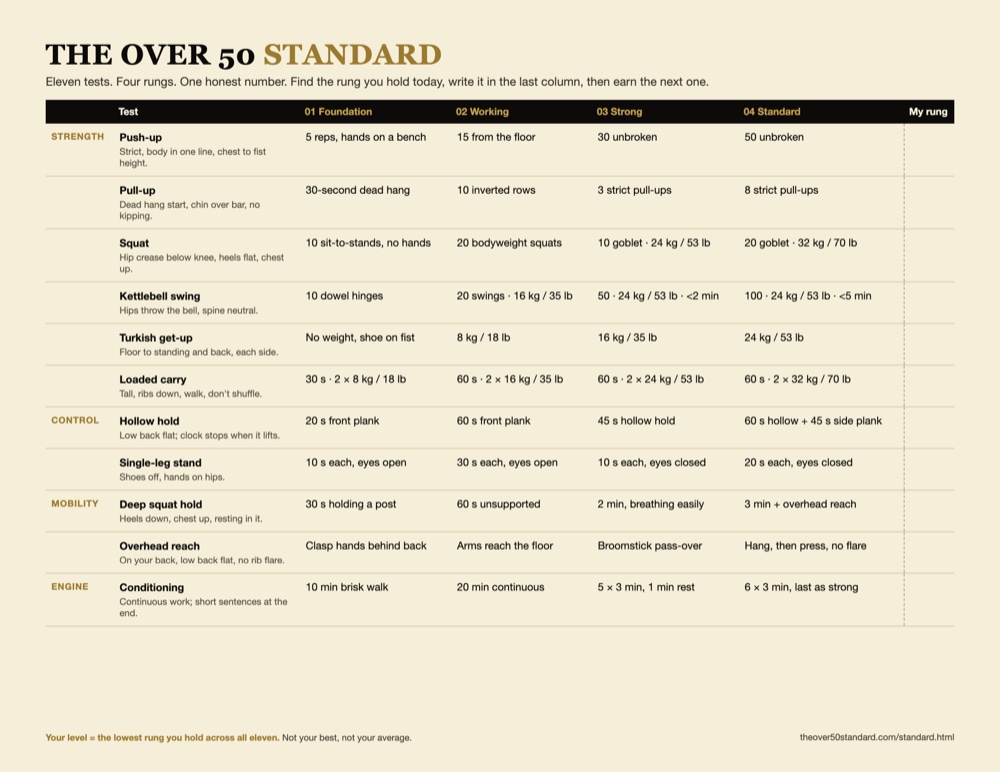
Before any of that, run the eleven tests once. Not to feel bad about the numbers, but because a comeback without a starting number is just a vibe.
The tests take about forty minutes in one session and they tell you which of the four rungs you are on. More usefully, they tell you which single test is furthest behind, and that test is where a comeback should point.
Almost everybody finds the same thing: strength came back faster than mobility and balance. Push-ups return in weeks. A deep squat hold and a twenty second single-leg stand with the eyes closed take months, and nobody trains them because nobody measures them.
The two mistakes
The first is training to failure because it feels like effort. Failure is a tool for people whose tissue tolerance is already built. In month one it is just damage you cannot yet repair on schedule.
The second is skipping the warm-up because you never used to need one. At twenty-five, the first set was the warm-up. That stops being true somewhere in the forties and pretending otherwise is how shoulders get hurt.
Five minutes: something that raises the heart rate, something that opens the mid-back, and the first movement of the session done with nothing in your hands.
What to expect, honestly
Strength returns quickly and visibly for about twelve weeks, because you are recovering old ground rather than breaking new. Then it slows, and that is normal, not a plateau to panic about.
Balance improves faster than anything else on the list. It is the cheapest thing to train and almost nobody trains it. Thirty seconds on each leg while the kettle boils is a complete programme.
Mobility is the slowest and the most worth it. Nothing on this site takes longer than turning an impossible deep squat into a comfortable one, and nothing else changes as much about how the next twenty years feel.